
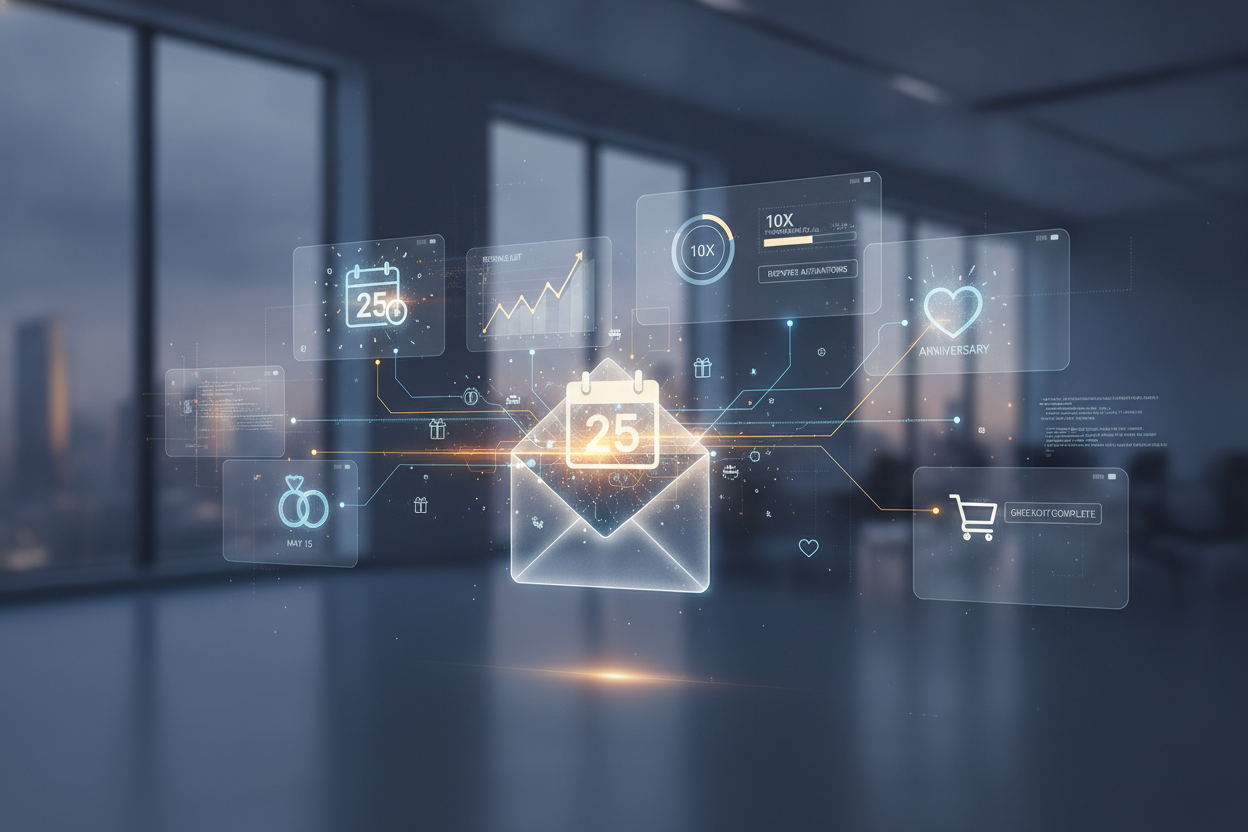
Lifecycle triggered emails, including birthday messages, anniversary sends, and behavioral milestone campaigns, consistently outperform batch-and-blast promotions by a wide margin. They generate transaction rates up to 10 times higher than standard promotional emails because they arrive at moments when the subscriber is already primed to engage. Understanding how to build, time, and optimize these automations is what separates email programs that produce predictable revenue from those that hope for it.
The average email marketer sends the same campaign to their entire list on Tuesday morning and calls it a strategy. Meanwhile, the brands producing outsized returns from email have invested in triggered workflows that fire based on individual subscriber data: a birthday approaching, an account anniversary, a spending threshold crossed, or a period of inactivity about to tip into churn. These are not novelty sends. They are revenue infrastructure. Experian's research has shown that birthday emails can generate 342% higher revenue per email than standard promotional messages. That number is not a rounding error; it reflects what happens when relevance and timing converge.
The foundation of any lifecycle trigger program is clean, reliable data. You cannot send a birthday email if you never collected the birth date, or if the date is stored in three different formats across two databases. Before building a single automation, audit the subscriber data you actually have. Birth dates, account creation dates, first purchase dates, last engagement dates, and purchase frequency are the minimum viable dataset for a lifecycle trigger program. If your data is messy, start with a progressive profiling strategy: ask for one additional data point per interaction, embedded in preference centers or post-purchase surveys, until you have enough to fuel meaningful automations.
Once the data is clean, the architecture of the triggered workflow matters more than most practitioners realize. A birthday email is not one email. The highest-performing birthday programs use a series of two to three messages: a pre-birthday teaser sent three to five days before the date, the birthday message itself with a clear offer, and a reminder sent two to three days after if the offer has not been redeemed. This series approach typically lifts redemption rates 30% to 50% compared to a single send, because it creates anticipation and urgency without requiring the subscriber to act on the exact day.
Birthday triggers get all the attention, but they are only one category of lifecycle milestone. Account anniversaries ("You've been with us for one year") reward loyalty and reduce churn. Purchase anniversaries ("It's been 12 months since you bought X, time to reorder?") drive repeat revenue with minimal creative effort. Spending milestones ("You've spent $500 with us this year, here's something special") create gamification without building a formal loyalty program. Engagement milestones ("You've read 50 articles" or "You've attended 10 webinars") reinforce the habit loop that keeps subscribers active. Each of these milestones is a trigger waiting to be built, and each one compounds the value of your subscriber file over time.
The creative treatment of lifecycle triggers deserves more care than it usually receives. Too many birthday emails look like they were designed by someone who has never received a birthday present: a generic "Happy Birthday!" subject line, a stock photo of balloons, and a 10% discount code. The brands that generate real revenue from these sends treat them the way a good salesperson treats a client relationship. They reference the subscriber's name, their history with the brand, and the specific offer they are most likely to care about based on past behavior. A subscriber who has only ever purchased women's shoes does not need a birthday coupon for men's outerwear.
Personalization in lifecycle emails extends beyond merge tags. Dynamic content blocks that change based on purchase history, browse behavior, or geographic location turn a triggered template into something that feels individually crafted. If your email platform supports conditional logic in its template engine, you can build a single birthday template that renders differently for a first-time buyer, a VIP customer, and a lapsed subscriber, each seeing a different offer, different imagery, and different copy. This is where automation builders like Rithm Builder earn their keep: the ability to set branching logic within a triggered workflow, so the right version of the right message reaches the right subscriber without manual intervention.
Timing is the variable that separates good lifecycle programs from great ones. A birthday email that arrives at 3 a.m. is technically on time but practically invisible, buried under 40 other messages by the time the subscriber checks their inbox over morning coffee. Send-time optimization, whether rule-based or algorithmic, makes a measurable difference. Platforms that analyze individual engagement patterns and deliver each triggered message during that subscriber's highest-probability engagement window can push open rates 10% to 15% higher than fixed-time sends. Market Rithm's Adaptive Delivery technology applies this at the infrastructure level, routing each triggered message through the optimal path and timing for that individual recipient.
One mistake that can undermine even a well-built lifecycle program is ignoring suppression and frequency logic. If a subscriber's birthday falls on the same day as a major promotional send, and they also triggered a cart abandonment email that morning, they could receive three messages from you in a single day. That is not personalization; it is noise. Smart frequency capping within your automation platform should ensure that lifecycle triggers respect the broader sending calendar. Priority hierarchies help here: a birthday email with a high-value offer should suppress a lower-priority promotional send, not compete with it in the same inbox on the same morning.
Measurement for lifecycle triggered emails requires a slightly different lens than standard campaign reporting. Because these sends go to individuals rather than segments, the volume per day is low, and short-term metrics can be noisy. Evaluate performance in rolling 30 or 90-day windows. Track revenue per email, redemption rate, and downstream engagement (did the subscriber open the next three sends after redeeming their birthday offer?) rather than fixating on daily open counts. The real value of lifecycle triggers is cumulative: they train subscribers to expect value from your emails, which lifts engagement across your entire program over time.
| Trigger Type | Avg. Open Rate | Avg. Revenue Lift vs. Promo | Recommended Series Length |
|---|---|---|---|
| Birthday | 45-52% | +342% | 2-3 emails |
| Account Anniversary | 35-40% | +100-150% | 1-2 emails |
| Purchase Anniversary | 38-42% | +200-250% | 2 emails |
| Spending Milestone | 30-35% | +80-120% | 1 email |
| Engagement Milestone | 33-38% | +60-90% | 1 email |
Building a lifecycle trigger program does not require perfection on day one. Start with one trigger, the birthday series if you have birth date data, or the account anniversary if you do not. Build a three-email series, set the branching logic, QA it thoroughly (test every date edge case, including February 29), and let it run for 90 days. Measure results. Iterate on the offer, the timing, and the creative. Then add a second trigger. Then a third. Within six months, you will have a set of always-on automations producing consistent revenue without anyone on your team pressing "send."
The compounding effect is the part that most teams underestimate. Each lifecycle trigger you add does not just generate its own revenue; it trains subscribers to open, click, and convert on your emails generally. Higher engagement signals flow back to mailbox providers, improving your sender reputation, which improves inbox placement for every campaign you send. It is a flywheel. The brands running five or six lifecycle triggers alongside their standard campaigns are not just capturing milestone revenue. They are building an email program that gets stronger every month, because every triggered message makes the next batch send more likely to land in the primary inbox.
If you are running an email program without lifecycle triggers, you are leaving the easiest, highest-ROI revenue on the table. Start small. Get the data right, build one series, measure it honestly, and expand from there. The infrastructure exists to make this straightforward; the only real barrier is deciding to prioritize it.
What is the best time to send a birthday email?
The highest-performing birthday emails arrive in the subscriber's inbox during their personal peak engagement window, which varies by individual. If you lack individual-level send-time data, early morning (6-8 a.m. in the subscriber's local time zone) on the birthday itself is a reliable default. The pre-birthday teaser should arrive three to five days before, and the reminder two to three days after, to maximize redemption.
How do I collect birth dates without annoying subscribers?
Progressive profiling works best. Ask for the birth date as a single-field question in your preference center, in a post-purchase follow-up email, or during account creation. Frame it as a benefit: "Tell us your birthday so we can send you something special." Avoid requiring full birth year if you only need the month and day; asking for less data reduces friction and privacy concerns.
Should lifecycle emails include a discount or a non-monetary reward?
It depends on your business model and margin structure. Discounts drive higher immediate redemption rates, but exclusive content, early access, or free shipping can outperform percentage-off offers for brands with strong affinity. Test both approaches over a 90-day period and measure revenue per email, not just redemption rate, to find the right answer for your audience.
How many lifecycle triggers should I run simultaneously?
Start with one and add triggers incrementally as you validate performance. Most mature email programs run four to six lifecycle triggers concurrently: birthday, account anniversary, purchase anniversary, spending milestone, and one or two behavioral triggers like re-engagement or replenishment reminders. The limiting factor is usually data quality and frequency management, not platform capability.
Do lifecycle triggered emails affect my sender reputation?
They typically improve it. Because lifecycle triggers are sent to engaged, opted-in subscribers at high-relevance moments, they generate above-average open and click rates. Those positive engagement signals strengthen your sender reputation with mailbox providers over time. The key is ensuring proper list hygiene and validation so that triggered sends do not fire to invalid or abandoned addresses, which would have the opposite effect.
