
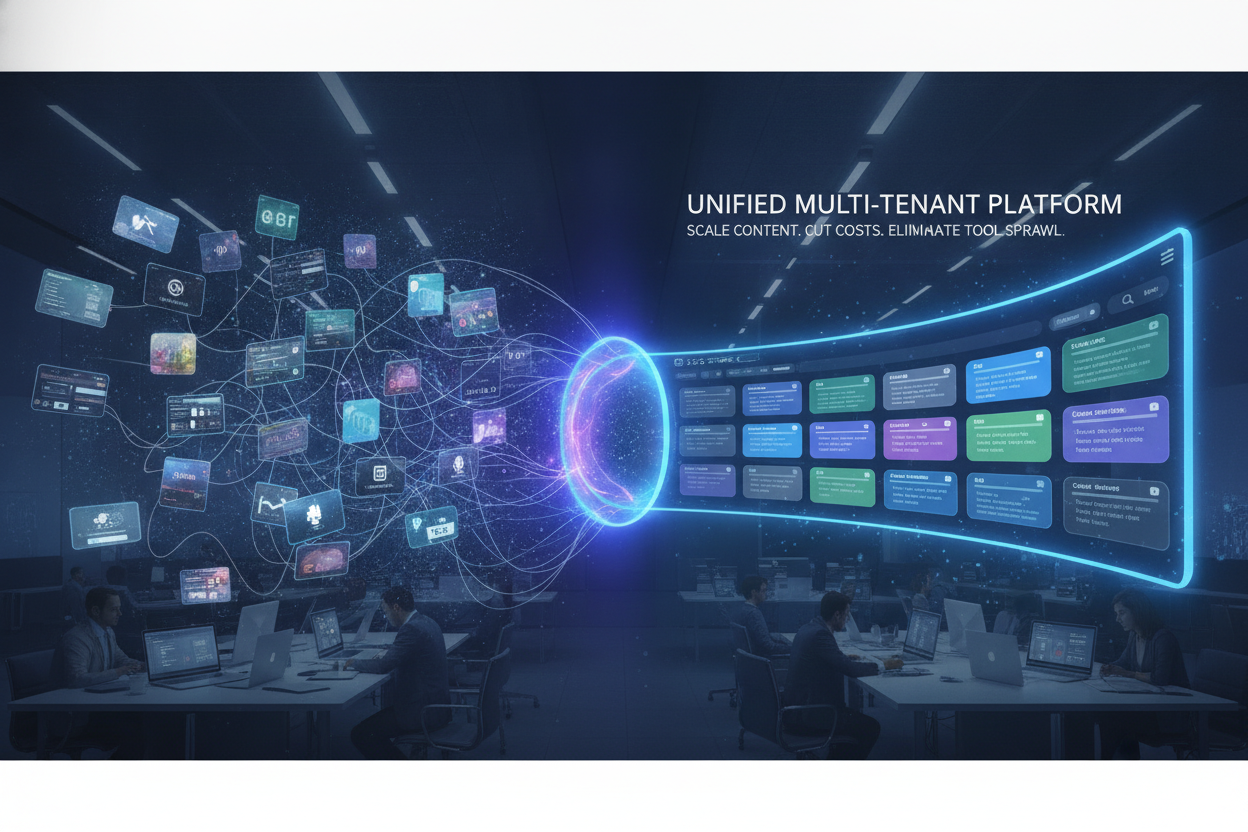
Agencies that manage content for more than a handful of clients inevitably face a compounding infrastructure problem: every new account introduces another login, another publishing workflow, and another integration point that someone on the team has to maintain. A unified multi-tenant platform collapses those separate environments into a single operational layer, letting agencies onboard clients in hours instead of weeks, maintain consistent quality across dozens of properties, and protect margins that tool sprawl quietly erodes.
The math on disconnected tools is worse than most agency owners realize. A mid-size agency running 25 client websites might subscribe to a CMS, a separate SEO plugin suite, a content calendar tool, a design asset manager, and an analytics connector for each property, or at least for each cluster of properties. The direct subscription costs alone can reach five figures monthly. But the real damage shows up in labor: the account manager toggling between four dashboards to answer a client question, the developer maintaining custom integrations that break after every platform update, the content strategist who cannot reuse a workflow template because each client lives in a different system. Those hours are invisible on a SaaS invoice, but they show up clearly on a P&L statement.
A survey published by Gartner in 2023 found that the average enterprise marketing organization uses 11 different MarTech solutions, up from nine two years prior. Agencies often exceed that number because they inherit their clients' tool preferences on top of their own internal stack. The result is a kind of operational debt: each tool adds marginal capability, but the cumulative integration and context-switching cost grows faster than the marginal value. At some point, your team spends more time operating tools than doing the work the tools are supposed to support.
Multi-tenant architecture solves this by design, not by integration. In a true multi-tenant system, every client exists as a separate, permissioned tenant within a shared platform instance. The underlying infrastructure (hosting, CMS engine, content pipelines, user management, billing) is centralized. Each tenant gets its own data isolation, branding, and configuration, but the agency operates from one control plane. This eliminates the per-client infrastructure overhead that scales linearly in a disconnected stack.
The distinction between multi-tenant and simply "managing multiple accounts" matters more than it seems. Many traditional CMS platforms let you create multiple sites, but each site is effectively a standalone installation with its own plugin dependencies, update cycles, and failure modes. When WordPress powers 30 client sites, you have 30 separate update queues, 30 plugin compatibility matrices, and 30 potential security surfaces. Multi-tenant platforms, by contrast, update once at the platform level. Security patches propagate to all tenants simultaneously. A workflow improvement you build for one client can be templated across every tenant in minutes.
This architectural difference compounds over time. In the first year, the operational savings might look modest: a few hours per week in reduced maintenance. By year three, when the agency has scaled from 25 clients to 60, the gap between a multi-tenant operation and a fragmented stack becomes enormous. The agency running multi-tenant can triple its client count without tripling its operations team. The agency running disconnected tools cannot.
| Operational Factor | Disconnected Stack (25 clients) | Multi-Tenant Platform (25 clients) |
|---|---|---|
| Avg. new client onboarding time | 3–6 weeks | 24–48 hours |
| Platform logins per team member | 8–15 | 1 |
| Monthly maintenance hours (est.) | 60–100 | 5–10 |
| Workflow reuse across clients | Manual recreation | One-click template |
| Security patch propagation | Per-site, staggered | Simultaneous, platform-level |
White-label capability is another dimension that only multi-tenant platforms handle cleanly. Agencies that resell content management or web publishing to their clients need each property to look and feel independent. In a fragmented stack, white-labeling is a customization project per client. In a multi-tenant system, it is a configuration setting: swap logos, domains, color palettes, and permission sets within a single administrative session. This is the approach behind platforms like Structure CMS, which was built specifically to let agencies and publishers manage dozens or hundreds of properties from one multi-tenant environment with full white-label control.
Content operations gain a specific advantage when everything shares a data layer. When your CMS, your AI content tools, and your publishing workflows all live on the same platform, you can build production pipelines that would be prohibitively complex in a disconnected environment. Consider the workflow where an AI content engine drafts initial copy, a human editor refines it, the approved piece is scheduled across three client properties with localized metadata, and performance data feeds back into the editorial calendar for the next planning cycle. In a disconnected stack, that workflow requires at least four tools and three integrations. Each integration is a potential failure point and a latency bottleneck. On a unified platform, it is a single pipeline with built-in editorial gates. Tools like Aight, which handles AI content generation within the same ecosystem as content management, illustrate how this consolidation turns a multi-step, multi-tool process into something a single content operator can manage at scale.
There is a legitimate counter-argument: best-of-breed tools in each category can outperform any single platform's version of that feature. This is often true in isolation. A dedicated SEO analytics tool may have deeper crawl data than any CMS's built-in SEO module. A standalone email platform may have more granular segmentation than a unified suite's email component. The question for an agency operator is whether that incremental capability justifies the integration overhead, the additional vendor relationship, the separate billing cycle, and the training cost for the team. In most cases, the answer changes as you scale. At five clients, the best-of-breed approach is manageable. At 40 clients, it becomes a full-time job just to keep the connective tissue intact.
Productization is the real strategic unlock. When an agency builds its delivery model on a multi-tenant platform, it can package and price services as repeatable products rather than bespoke projects. A "content-as-a-service" offering becomes operationally feasible because the infrastructure supports standardized delivery. Client onboarding becomes a checklist, not a project plan. QA becomes automated, not manual. Reporting becomes a dashboard, not a monthly deck that someone builds from scratch in Google Slides.
The financial impact compounds in two directions. Revenue per employee increases because the same team can manage more clients without proportional headcount growth. Client retention improves because delivery quality stays consistent; you are not relying on heroic individual effort to keep each account running smoothly. Market Rithm's own data reflects this dynamic: across its client base of 86 active logos, the company maintains a 93% client retention rate, a figure that correlates directly with the operational consistency that a unified platform enables.
Migration is the part nobody wants to talk about. Moving 30 client properties from disconnected tools to a unified platform is not a weekend project. It requires content audits, redirect mapping, permission architecture decisions, and client communication. The agencies that execute this successfully treat it as a six-to-12 month strategic initiative, not a sudden cutover. They migrate clients in cohorts, starting with new clients (who have no legacy to move) and smaller existing accounts (where the migration scope is manageable). By the time they reach their largest, most complex accounts, the team has refined the process and built internal playbooks.
The cost of not migrating is harder to see but easier to calculate once you start tracking the right metrics. Pull your team's actual hours spent on platform administration, integration debugging, and cross-tool data assembly over the last quarter. Multiply by your fully loaded hourly cost. That number is your tool sprawl tax. For most mid-market agencies, it falls somewhere between $8,000 and $25,000 per month in labor alone, before you count the SaaS subscriptions themselves.
Agencies that consolidate onto a unified multi-tenant platform do not eliminate complexity. They relocate it. Instead of complexity distributed across a dozen tools and integration layers, it sits in one system where it can be managed, measured, and systematically improved. That shift, from distributed chaos to centralized operations, is what separates agencies that scale profitably from agencies that grow revenue while watching margins shrink. If you are evaluating your stack, the Structure CMS approach to multi-tenant content operations is worth examining as a reference architecture, whether or not it ends up being the platform you choose.
What is a multi-tenant CMS and how does it differ from a regular CMS?
A multi-tenant CMS hosts multiple client sites or properties within a single platform instance, with each client (tenant) getting isolated data, branding, and permissions. A traditional CMS typically requires a separate installation per site, which means independent update cycles, plugin management, and security maintenance. The multi-tenant model centralizes infrastructure while preserving per-client customization, reducing operational overhead significantly as the number of managed properties grows.
How much time does a unified platform actually save compared to a disconnected MarTech stack?
Estimates vary by agency size, but most mid-market agencies managing 20 or more client properties report 50 to 80 hours per month in reduced platform administration, integration maintenance, and cross-tool data reconciliation after consolidation. New client onboarding often drops from three to six weeks to under 48 hours. The labor savings alone typically exceed the cost difference between multiple subscriptions and a single unified platform within the first quarter.
Does consolidating tools mean sacrificing best-of-breed capabilities?
In some narrow use cases, yes. A dedicated point solution may have deeper functionality in its specific category than a unified platform's equivalent module. However, the integration overhead, vendor management complexity, and training costs of maintaining multiple best-of-breed tools often exceed the incremental capability gain, especially as you scale past 10 to 15 client accounts. The tradeoff favors consolidation for most agency operations.
What should agencies look for when evaluating a multi-tenant content platform?
Four capabilities matter most: true data isolation between tenants (not just separate folders), white-label support at the domain and branding level, role-based permissions that can be configured per tenant, and a unified content pipeline that supports templates and workflow reuse across clients. Secondary factors include built-in AI content tools, API extensibility, and whether the platform handles billing and onboarding natively or requires external connectors.
How long does it realistically take to migrate from a disconnected stack to a unified platform?
For a mid-size agency with 20 to 40 client properties, a full migration typically takes six to 12 months when executed as a phased initiative. Agencies that try to migrate everything at once usually experience service disruptions and team burnout. The recommended approach is to start with new client onboarding on the new platform immediately, then migrate existing clients in cohorts of three to five, beginning with the smallest and simplest accounts.
