
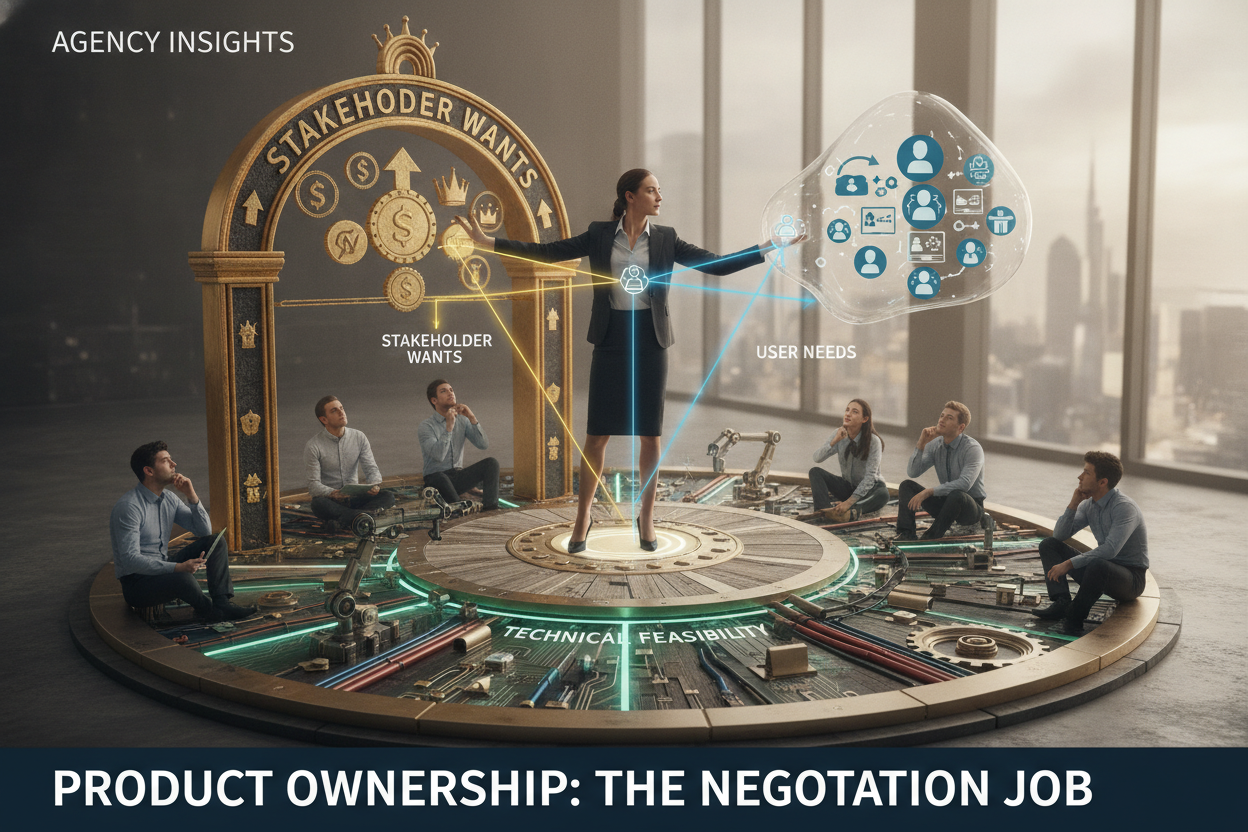
Product ownership is a negotiation job disguised as a strategy role. The best product owners spend less time writing user stories and more time brokering agreements between three forces that rarely align: what stakeholders want, what users actually need, and what the engineering team can deliver within real constraints. Understanding how to weigh those forces, and when to push back on each of them, is the difference between a product that ships and grows and one that stalls under the weight of competing agendas.
Most frameworks treat these three inputs as if they carry equal weight at all times. They do not. The ratio shifts depending on where you are in the product lifecycle, how much validated data you have about user behavior, and whether you are building net-new functionality or iterating on something that already exists. A product owner launching a new module for an agency-facing platform is making fundamentally different tradeoff decisions than one optimizing a mature checkout flow. The skill is recognizing which input deserves the most influence at any given moment, and having the credibility to enforce that judgment.
Stakeholder input is the loudest of the three forces, which is exactly why it needs the most careful management. Executives, sales leaders, client success managers, and board members all have legitimate perspectives on what the product should do. The problem is that stakeholder requests almost always arrive as solutions, not problems. "We need a dashboard that shows X" is a solution. The underlying problem might be that clients cannot self-serve on reporting, or that account managers are spending four hours a week pulling data manually. When a product owner translates stakeholder requests back into problem statements, two things happen: the solution space opens up, and the stakeholder feels heard without locking the team into a specific implementation. This translation work is unglamorous. It is also the single most valuable thing a product owner does on a weekly basis.
There is a particular failure mode that shows up in agencies and MarTech companies more than anywhere else. A large client asks for a feature. The sales team or account team escalates it with urgency. The product owner, under pressure to retain revenue, fast-tracks it. Six months later, the feature is live, the client that requested it barely uses it, and the engineering team lost a quarter they could have spent on infrastructure that would have benefited every client. This pattern repeats because organizations confuse client requests with user needs. A client request is one data point. A user need is a pattern validated across multiple signals: support tickets, usage analytics, churn interviews, competitive analysis, and direct observation. One is anecdotal. The other is evidence.
User research does not require a dedicated research team or a six-figure budget. The most effective product owners build lightweight feedback loops into their weekly rhythm. Watching three users interact with a feature through screen recordings tells you more than a 40-slide market analysis. Reading the last 50 support tickets in a product area reveals patterns that no stakeholder meeting will surface. The point is not to become a full-time researcher; it is to make user evidence a non-negotiable input into every prioritization decision. When you walk into a roadmap review and can say "here is what 200 users actually did when they encountered this workflow," the conversation changes. Data does not eliminate disagreement, but it raises the quality of the disagreement considerably.
Technical feasibility is the input that product owners most often underestimate or misunderstand. There is a difference between "we cannot build this" and "we can build this, but it will create maintenance burden that slows us down for the next 18 months." Engineering leaders sometimes compress complex tradeoffs into a simple "that is hard" because they have learned that nuanced explanations get steamrolled in prioritization meetings. A good product owner creates the space for engineers to explain the second and third-order consequences of technical decisions. They ask questions like: "If we build this the fast way, what does that cost us in six months?" and "What would we need to change about the architecture to make this easy instead of hard?" Sometimes the answer reveals that a foundational investment now makes three future features trivial. Sometimes it reveals that the "quick win" a stakeholder wants would require rewriting a core service.
The most sophisticated version of this skill is understanding how platform architecture constrains and enables product decisions. Agencies running their operations on a patchwork of disconnected tools face this constantly. When your CMS, your email system, your analytics, and your content generation tools all live on separate data layers, every product decision carries an integration tax. A product owner working inside a unified platform, where content management, deployment, and AI-powered generation share the same infrastructure (the kind of architecture that Market Rithm was built around), can say yes to feature requests that would take weeks on a fragmented stack. Platform architecture is not just an engineering concern; it is a product strategy lever.
Prioritization frameworks are worth knowing even if you do not follow any of them religiously. RICE (Reach, Impact, Confidence, Effort) gives you a common language for comparing dissimilar initiatives. The Kano model helps you distinguish between features users expect as baseline, features that increase satisfaction linearly, and features that create disproportionate delight. Weighted scoring matrices let you make your criteria explicit so stakeholders can argue about the weights rather than the outcomes. None of these frameworks will make the decision for you. What they do is make your reasoning visible. When a VP asks why their pet feature is not on the roadmap, you can point to the scoring rather than having a subjective debate. Transparency in prioritization is how product owners build trust over time, and trust is the currency that lets you say "no" when you need to.
| Input Source | Common Bias | Corrective Practice |
|---|---|---|
| Stakeholders | Requests arrive as solutions, not problems | Translate every request into a problem statement before evaluating |
| Users | Stated preferences differ from actual behavior | Supplement surveys with behavioral data and session recordings |
| Engineering | Complexity is communicated as binary (easy/hard) | Ask about second-order costs and architectural tradeoffs explicitly |
Saying no is the part of product ownership that no certification course prepares you for. Every yes to one initiative is an implicit no to several others. The backlog is not a to-do list; it is a graveyard of things you chose not to do yet. Product owners who struggle with this end up with bloated roadmaps that promise everything and deliver nothing on time. The discipline is in making fewer, higher-conviction bets and communicating clearly about what is not happening and why. "We are not building X this quarter because the data shows Y is a higher-impact problem, and our engineering capacity is committed to Z" is a complete answer. It will not make everyone happy. It will make the people who matter respect your process.
Communication patterns matter more than most product owners realize. A weekly stakeholder update that takes 15 minutes to write can prevent hours of ad hoc interruptions. A shared, living roadmap document (not a slide deck that goes stale the day after the quarterly review) keeps everyone anchored to the same plan. When product owners working in platforms like Structure CMS can point to real usage data, content performance metrics, and client-facing outputs from the same system they are building within, the feedback loop between "what we shipped" and "what impact it had" tightens dramatically. That feedback loop is what turns product ownership from opinion-driven to evidence-driven.
There is also a human dimension to this work that gets overlooked in frameworks and methodologies. Stakeholders are not obstacles. They are people with real accountability, real pressures from their own leadership, and real expertise in their domain. The product owner who treats a sales VP's feature request as an annoyance is making a political mistake that will cost them later. The better approach is genuine curiosity: "Help me understand the client situation driving this request." "What happens if we solve the underlying problem a different way?" These conversations take time. They also build the kind of cross-functional relationships that make a product organization actually function, rather than just exist on an org chart.
The product owners who consistently ship valuable software tend to share a few traits. They maintain a short list of the three to five problems that matter most, and they resist expanding that list even when the pressure to do so is intense. They spend as much time with users as they do with stakeholders. They have enough technical understanding to know when an engineering estimate is padded and when it reflects genuine complexity. And they communicate decisions with enough context that the people who disagree with them still trust the process. None of this is magic. It is discipline, applied consistently, in a role that constantly tempts you to abandon it.
If you are building or refining your product ownership practice, start with the tradeoff you are worst at. If you default to stakeholder demands, invest in user research infrastructure. If you over-index on user feedback without understanding technical costs, schedule weekly architecture reviews with your engineering lead. If you have strong technical intuition but struggle to align executives, build a transparent prioritization framework and share it before anyone asks for it. The goal is not perfect balance; it is informed, intentional imbalance that shifts as your product and organization evolve.
What is the hardest part of being a product owner?
The hardest part is consistently saying no to requests that seem reasonable in isolation but do not serve the product's strategic direction. Every stakeholder has legitimate needs, and turning down a request from a revenue-generating client or a senior executive requires both data and political skill. Building a transparent prioritization process makes these conversations easier over time.
How should product owners handle conflicting stakeholder priorities?
Start by translating every request into a problem statement rather than evaluating competing solutions. Often, two stakeholders asking for different features are responding to the same underlying problem. When you reframe the conversation around problems and evidence, it becomes possible to find solutions that satisfy multiple stakeholders without building two separate features.
How much technical knowledge does a product owner need?
You do not need to write code, but you need to understand architectural tradeoffs well enough to ask informed questions. Knowing the difference between a feature that fits cleanly into the existing platform and one that requires foundational changes will prevent you from making commitments the engineering team cannot keep. Regular one-on-one conversations with your technical lead are worth more than any certification.
When should user needs override stakeholder wants?
User needs should carry the most weight when you have behavioral data showing a clear gap between what users are trying to accomplish and what the product currently supports. Stakeholder input is most valuable early in the product lifecycle or when entering a new market where direct user data is limited. The ratio shifts; a strong product owner adjusts deliberately rather than defaulting to whoever speaks loudest.
What tools help product owners manage competing priorities?
Frameworks like RICE scoring and the Kano model help structure prioritization conversations. Beyond frameworks, the most impactful tool is a unified platform that gives you visibility across content, user behavior, and engineering capacity in one place. Platforms designed for multi-tenant operations, such as Market Rithm's unified stack, reduce the integration overhead that often distorts product priorities by turning simple features into complex cross-system projects.
