
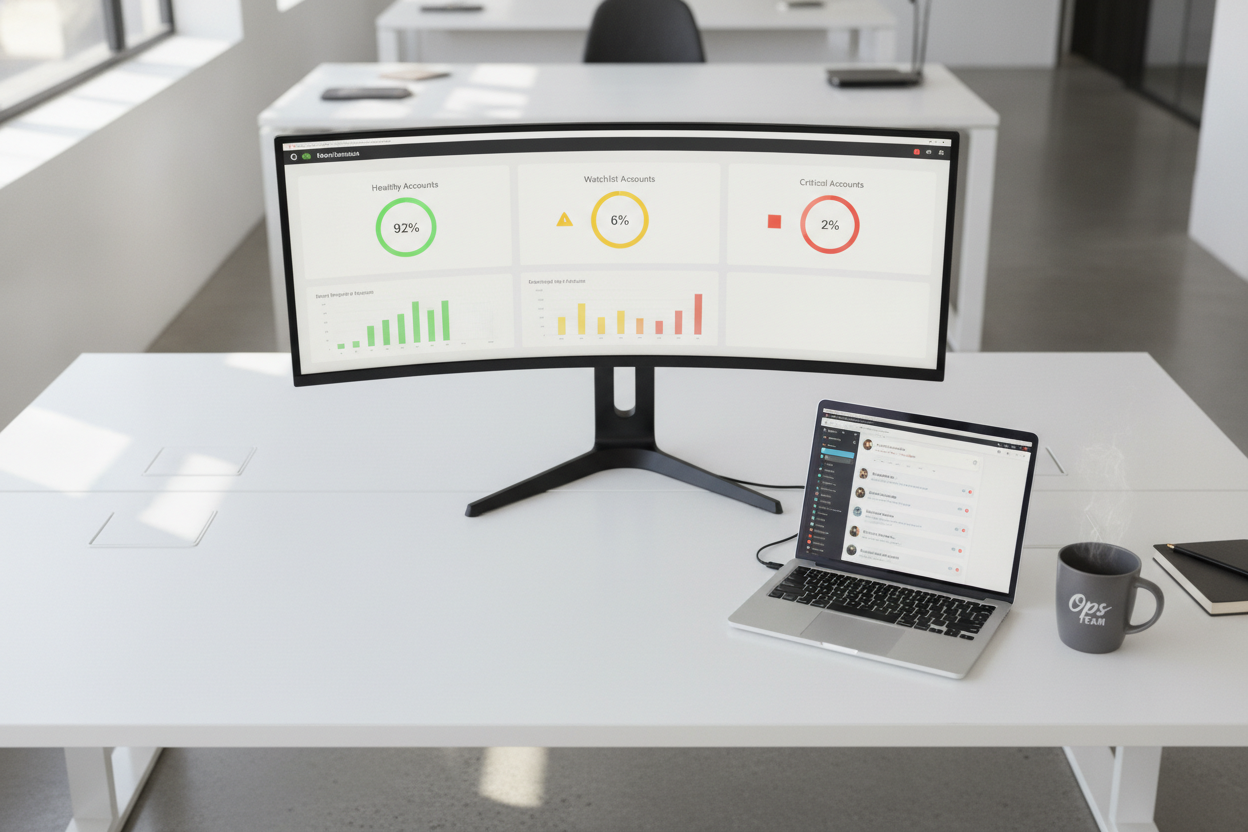
Tech touch customer success is the practice of using automated, data-driven communication to manage large volumes of lower-revenue accounts without assigning a dedicated customer success manager to each one. Done well, it protects retention rates that rival high-touch programs at a fraction of the cost. Done poorly, it turns your smallest customers into your loudest detractors.
Most SaaS companies arrive at the tech touch conversation the same way: their CS team is drowning. The math stops working somewhere around 200 accounts per CSM, and the response is usually one of two bad options. Either you hire aggressively and watch your cost-to-serve eat your margins, or you quietly neglect the long tail and hope nobody notices. The third option, building a real tech touch motion, is the only one that scales. But it requires more operational discipline than most teams expect.
The core mistake companies make when designing a tech touch program is treating it as "high touch minus the human." They strip out the CSM, keep the same lifecycle emails, and wonder why engagement craters after onboarding. The problem is that tech touch is not a degraded version of high touch. It is a fundamentally different operating model with its own design principles, its own success metrics, and its own failure modes.
Pull Quote: "Tech touch is not high touch with the human removed. It is a different operating model that requires its own design logic."
Start with segmentation, but not the lazy kind. Most companies segment by ARR alone: accounts above $X get a named CSM, accounts below $X get automation. This is better than nothing, but it misses the point. The right segmentation model considers at least three dimensions: revenue (current ARR and expansion potential), complexity (product usage breadth, integration depth, number of users), and risk profile (industry churn benchmarks, contract terms, support ticket patterns). A $500/month account with 47 active users across three departments is a fundamentally different retention challenge than a $500/month account with one admin who logs in twice a week. Treating them identically because they share a price point is how you lose the first one.
Once you have your segments defined, the real work begins: designing the automated lifecycle. A strong tech touch program has four layers, and each one serves a distinct purpose. The first layer is onboarding automation. This is not a welcome email and a link to your knowledge base. It is a sequenced, behavior-triggered set of communications that guide new accounts through activation milestones. If your product has three features that correlate with 90-day retention, your onboarding sequence should be engineered to drive adoption of those three features, in order, with specific calls to action and fallback paths for accounts that stall. The second layer is ongoing engagement, typically product tips, feature announcements, and usage-based nudges that keep accounts active and expanding. The third layer is risk intervention: automated alerts and outreach triggered by usage drops, support sentiment shifts, or approaching renewal dates. The fourth layer is expansion signaling, where you surface upsell opportunities to your sales team based on usage patterns that indicate a customer is outgrowing their current plan.
The onboarding layer deserves extra attention because it is where most tech touch programs either earn their ROI or quietly fail. Research from customer success practitioners consistently shows that the strongest predictor of long-term retention is time-to-first-value. For tech touch accounts, you cannot rely on a CSM to shepherd someone through setup. The product and the automation have to do that work together. This means your onboarding emails need to be specific to the customer's use case (not generic "getting started" content), triggered by what the customer has and has not done (not sent on a fixed calendar), and short enough to act on in under two minutes.
| Dimension | Fixed Schedule | Behavior-Triggered |
|---|---|---|
| Email timing | Day 1, Day 3, Day 7, Day 14 | After signup, after first login, after first feature use, after stall detected |
| Content relevance | Generic product overview | Specific to what the user has or has not done |
| Stall detection | None until renewal review | Triggers fallback sequence within 48 hours |
| Typical activation rate | 30-45% | 55-70% |
Health scoring is the engine that makes all four layers work. Without a reliable health score, your automation is just batch email on a timer. A good tech touch health score combines product usage data (login frequency, feature adoption, breadth of user engagement), support data (ticket volume, sentiment, resolution time), and commercial data (contract renewal date, payment history, expansion signals). The score does not need to be perfect on day one. It needs to be directionally correct and continuously calibrated. Start with five or six signals you trust, weight them based on what you have seen drive churn or retention historically, and commit to reviewing the model quarterly. The companies that struggle with health scoring are almost always the ones that tried to build a perfect model before shipping anything. Ship a simple model, watch where it is wrong, and improve it.
One of the underappreciated challenges of tech touch is knowing when to break the automation and involve a human. Pure automation works for routine lifecycle moments, but there are inflection points where a well-timed human touch makes an outsized difference: a major product outage affecting the account, a spike in user additions suggesting organizational expansion, a champion leaving the company (detectable through login pattern changes), or a health score dropping below a critical threshold for more than two consecutive weeks. Your tech touch system should have clear escalation rules that route these moments to a pooled CS team or a dedicated digital CSM. The goal is not zero human contact. The goal is human contact precisely where it changes outcomes, and automation everywhere else.
Platforms that support AI-powered customer communication can significantly reduce the cost of those human-touch escalation moments. Instead of a CSM drafting a personalized email from scratch, an AI layer can generate context-aware outreach based on the account's usage data and health trajectory, leaving the CSM to review and send rather than research and write. This is the approach behind tools like Aigotchu, which prices per conversation rather than per seat, making it economically viable to cover the long tail of accounts that would never justify a dedicated CSM but still benefit from intelligent, contextual communication when risk or opportunity signals fire.
Pull Quote: "The goal is not zero human contact. The goal is human contact precisely where it changes outcomes, and automation everywhere else."
Measurement is where tech touch programs earn organizational trust or slowly lose funding. The metrics that matter are not email open rates. They are activation rate (percentage of new accounts that reach your defined "activated" state within 30 days), net revenue retention for the tech touch segment (including expansion and contraction), time-to-escalation (how quickly your system identifies at-risk accounts and gets a human involved), and cost-to-serve per dollar of ARR retained. Track these monthly. Compare them against your high-touch segment. You will likely find that tech touch retention runs 5 to 15 percentage points below high touch in the first year, then narrows as your automation matures. If the gap is wider than 15 points, something in your lifecycle automation is broken, and usage data will tell you where.
The operational backbone of a tech touch program also matters more than people think. Your CS team still needs a way to manage the work that falls out of automation: escalated accounts, renewal campaigns, expansion plays. Running that work through a shared inbox or a spreadsheet creates the same visibility problems you had before you automated anything. A lightweight project management layer, something that supports continuous workflow rather than rigid sprint boundaries, gives pooled CS teams the structure to handle escalations without losing track of recurring lifecycle work. ScrumRithm was built for exactly this kind of perpetual, overlapping workflow, but whatever tool you use, the principle is the same: automation handles the volume, and your human team needs operational structure to handle the exceptions well.
Finally, do not underestimate the content investment. Tech touch runs on content: onboarding sequences, product education, feature announcements, renewal reminders, expansion nudges, re-engagement campaigns, NPS follow-ups. Each of these needs to be written, tested, and iterated. Most companies budget for the technology layer of tech touch and forget that someone has to write and maintain 40 to 60 distinct communication assets, refresh them as the product evolves, and A/B test them for effectiveness. Assign an owner. Build a content calendar. Treat your tech touch library like a product, not a one-time project.
Scaling customer success to your long tail is not a technology problem or a people problem. It is a design problem. The companies that do it well are the ones that treat tech touch as its own program with its own lifecycle logic, its own health model, its own escalation rules, and its own measurement framework. Get those four pieces right, and you will retain more of your smallest accounts than most companies retain of their largest ones.
What is tech touch customer success?
Tech touch customer success is a scaled approach to managing customer accounts using automated, data-driven communication instead of assigning a dedicated CSM to each account. It typically involves behavior-triggered onboarding sequences, automated health monitoring, and AI-assisted outreach. The goal is to deliver retention outcomes comparable to high-touch programs while serving hundreds or thousands of accounts efficiently.
How do you decide which accounts belong in a tech touch segment?
Segment by more than just revenue. Consider account complexity (number of users, integrations, feature breadth), expansion potential, and risk profile alongside ARR. A multi-dimensional segmentation model ensures that high-complexity accounts get appropriate human attention even if their revenue is below your high-touch threshold.
What metrics should you track for a tech touch program?
The four primary metrics are activation rate within 30 days, net revenue retention for the tech touch cohort, time-to-escalation for at-risk accounts, and cost-to-serve per dollar of ARR retained. Email engagement metrics like open rates are secondary indicators; the business outcomes they drive are what matter for program funding and iteration.
When should a tech touch account be escalated to a human?
Escalation should be triggered by health score drops sustained over two or more weeks, major product incidents affecting the account, champion departure signals, or expansion indicators like rapid user growth. Clear, automated escalation rules ensure these moments reach a pooled CS team quickly enough to change the outcome.
How much content does a tech touch program require?
Plan for 40 to 60 distinct communication assets across onboarding, ongoing engagement, risk intervention, and expansion workflows. Each asset needs to be maintained as your product evolves and tested for effectiveness. Treating your tech touch content library as a living product, with an owner and a refresh cadence, is what separates programs that scale from programs that stagnate.
