
The MarTech Explosion: From Manageable to Overwhelming
The 2016 Marketing Technology Landscape fit on a single poster. Categories were clearly defined. Integration paths were straightforward. Marketing teams could reasonably evaluate and select best-of-breed solutions in each category.
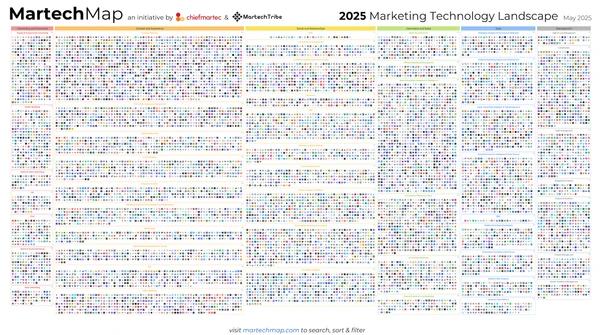
Fast forward to 2025, and the landscape is unrecognizable. The current MarTech Map resembles a dense pixel field more than a navigable ecosystem. Categories have fractured into micro-niches. Overlapping capabilities create confusion rather than choice. And the promised benefits of "best-of-breed" solutions have been replaced by the reality of "integration hell."
The Growth Nobody Needed
This 300% explosion in platform options didn't make marketing easier—it made it exponentially more expensive and complex.
The Hidden Costs of Platform Fragmentation
Marketing leaders see line-item costs for each platform: $3,000/month for marketing automation, $2,500/month for CRM, $1,800/month for email, $1,200/month for analytics. What they don't see are the compounding hidden costs that dwarf these subscription fees.
Integration Tax: The Largest Hidden Cost
Every additional platform in your stack requires integration with existing systems. These integrations fail, require maintenance, and create data synchronization issues that consume engineering resources:
- Initial integration development: $5,000-15,000 per platform connection
- Ongoing maintenance: $1,000-3,000 per integration annually
- Data mapping and cleanup: $10,000-25,000 for each major migration
- API monitoring and troubleshooting: 10-20 engineering hours monthly
A typical mid-market company with 8-12 marketing platforms spends $40,000-75,000 annually just maintaining integrations between systems that should naturally work together.
Feature Redundancy: Paying Multiple Times for the Same Capability
Modern marketing platforms have expanded their feature sets to compete with adjacent categories. The result? You're paying for the same capabilities multiple times:
Example: Email Capabilities Redundancy
- Your CRM includes email sending (rarely used)
- Your marketing automation platform has email capabilities (primary use)
- Your ESP provides transactional email (different account, same vendor)
- Your customer success platform sends lifecycle emails (fourth email system)
Result: You're paying for email functionality in four different platforms while actually consolidating sends in just one or two.
Training and Adoption Overhead
Each additional platform requires onboarding, training, and ongoing proficiency development. Marketing teams spend substantial time becoming proficient in platforms rather than executing marketing strategy:
- Initial training: 20-40 hours per team member, per platform
- Ongoing education: 10-15 hours annually for platform updates
- Knowledge documentation: Creating internal guides and processes
- Cross-training: Redundancy when team members change roles
For a 5-person marketing team managing 10 platforms, this represents 1,000-2,000 hours annually—equivalent to hiring an additional full-time employee just to maintain platform proficiency.
The Total Cost of Ownership Reality
Let's examine the actual TCO for a mid-market company ($10M-50M annual revenue) with a typical fragmented martech stack:
Typical Fragmented Stack: Annual TCO
Only 48% of total spend goes to actual platform capabilities. The remaining 52% is pure waste: integration tax, redundant features, and overhead.
The Enterprise Platform Trap
Frustrated by fragmentation, many mid-market companies consider "going enterprise" with platforms like HubSpot, Marketo, or Salesforce Marketing Cloud. This rarely solves the problem and often makes it worse:
The Pricing Cliff
Enterprise platforms claim to eliminate fragmentation through all-in-one capabilities. But their pricing creates a different problem:
- HubSpot Enterprise: $42,000-120,000+ annually (Marketing + Sales + Service Hubs)
- Marketo Engage: $35,000-60,000 annually (email/automation only)
- Salesforce Marketing Cloud: $50,000-250,000+ annually (complex pricing tiers)
- Adobe Experience Cloud: $100,000-500,000+ annually (enterprise contracts only)
Mid-market companies that need $100,000+ in actual platform capabilities face a stark choice: cobble together fragmented tools for $210,000 total cost, or pay enterprise platforms $200,000+ in subscription fees alone (before implementation, training, and customization).
The Complexity Problem
Enterprise platforms offer extensive capabilities, but most mid-market teams use only 20-30% of available features. The remaining 70-80% creates interface clutter, training overhead, and configuration complexity without delivering value:
🎯 The Mid-Market Dilemma
You need sophisticated capabilities but can't afford enterprise complexity or fragmentation costs.
The Integrated Stack Alternative
A third option exists between fragmented best-of-breed and monolithic enterprise platforms: purpose-built integrated stacks that deliver enterprise capabilities at mid-market prices through vertical integration.
How Vertical Integration Reduces TCO
Native Integrations Eliminate Integration Tax: When email, CMS, validation, and automation come from the same vendor with shared data models, integration costs disappear. No API maintenance, no data synchronization failures, no mapping complexity.
Unified Training Reduces Onboarding Overhead: Learning one interface paradigm across multiple products reduces training time by 60-70% compared to learning disparate platforms from different vendors.
Shared Infrastructure Reduces Redundant Costs: Single hosting infrastructure, unified user management, consolidated billing, and shared security compliance eliminate redundant operational costs.
Focused Feature Sets Eliminate Complexity: Purpose-built tools for specific use cases avoid the "everything to everyone" feature bloat that makes enterprise platforms unusable for mid-market teams.
Real-World TCO Comparison
52% waste
70% unused features
minimal waste
The integrated stack delivers equivalent or superior capabilities at 78% lower total cost than fragmented alternatives.
The Market Rithm Integrated Approach
Market Rithm's platform ecosystem demonstrates how vertical integration delivers enterprise capabilities without enterprise complexity or fragmentation costs:
Core Platform Integration
Deployer (Email Service Provider): Enterprise-grade email with proprietary Adaptive Delivery and Smart Suppressions. Native dwell time tracking eliminates the $25K-35K annual cost of third-party engagement analytics.
Structure CMS (Content Management): Multi-domain website management with 99.9974% uptime and 100M+ monthly pageviews. Native Deployer integration means email forms, subscriber data, and website visitor behavior flow seamlessly without API middleware.
Validate Plus (Email Validation): List hygiene and validation integrated directly into subscriber onboarding workflows. Real-time validation at point of capture prevents invalid data from entering your email database.
Account Console 2.0 (Administration & Billing): Unified user management, billing automation, and reporting across all platform products. Single sign-on, consolidated invoicing, and unified permissions eliminate administrative overhead.
Aigotchu (AI-Powered Customer Success): Comprehensive customer success platform with AI-assisted support, intelligent ticket routing, and automated engagement workflows. Replaces expensive solutions like Intercom, Zendesk, and Freshdesk at a fraction of the cost ($150-300/month vs. $500-2,000+).
The AI Advantage: Aight + Valet Working Across the Stack
What truly differentiates the integrated approach is how AI capabilities work across all platforms rather than being siloed within individual tools:
Aight AI Engine: The foundational AI layer that powers intelligent automation across the entire ecosystem. Using Anthropic's Claude and OpenAI APIs with RAG (Retrieval-Augmented Generation) architecture, Aight provides:
- Context-aware assistance: AI understands your data across Deployer, Structure, and Account Console
- Cross-platform optimization: Recommendations consider email performance, website behavior, and billing data simultaneously
- Predictive analytics: AI learns from your complete marketing stack, not isolated tools
- Natural language control: Ask questions or give commands in plain English across any platform
Valet AI Agents: Autonomous agents that execute tasks across the integrated stack without requiring separate integrations or workflows:
Example: Campaign Creation Valet Agent
Instead of manually creating campaigns across multiple platforms:
- Valet analyzes past campaign performance in Deployer
- Identifies high-performing content from Structure CMS
- Validates audience data via Validate Plus
- Creates campaign with optimized subject lines and send times
- Sets up automated follow-up sequences based on engagement
- Configures tracking and reporting in Account Console
- Monitors results and adjusts in real-time using Adaptive Delivery
All of this happens from a single conversational interface—no platform switching, no manual integrations.
Support Automation with Aigotchu: Valet agents in Aigotchu provide customer support across your entire marketing operations:
- Answer questions about email campaigns without accessing Deployer separately
- Troubleshoot website issues by analyzing Structure CMS logs and performance data
- Explain billing anomalies by correlating usage across all platforms
- Provide training and onboarding by accessing documentation from all products
In a fragmented stack, each platform would require its own AI implementation, separate training, and complex integrations to share context. With the integrated approach, AI capabilities compound across the ecosystem.
The Integration Advantage in Practice
Consider a typical workflow that would require multiple integrations in a fragmented stack:
Subscriber Acquisition → Support Workflow
- Visitor fills form on Structure CMS website
- Email automatically validated via Validate Plus (native, real-time)
- Valid subscriber added to appropriate Deployer list based on form source
- Aight AI analyzes subscriber behavior across website and email
- Welcome email series triggered with personalized content (Valet agent optimization)
- Engagement data flows back to Structure for behavioral tracking
- Billing automatically updated in Account Console based on new subscriber
- If subscriber has questions, Aigotchu provides support with full context of their journey
Integration Required: Zero. AI Agents Used: Aight + Valet working across the entire stack. This workflow is native functionality across the platform ecosystem.
In a fragmented stack, this same workflow requires:
- 4-6 API integrations between platforms
- Separate AI implementations in each tool (if available at all)
- Custom middleware to synchronize data
- Multiple support platforms with no shared context
- Manual data entry or complex Zapier workflows
- Each integration representing a potential failure point and ongoing maintenance burden
The Customer Success Cost Advantage
Aigotchu exemplifies how the integrated approach delivers enterprise functionality at mid-market prices:
Customer Success Platform Comparison
isolated platform
limited integrations
full stack integration
Aigotchu provides comparable functionality at 85-90% lower cost because it doesn't need to build or maintain integrations—it's natively part of the ecosystem.
Making the Business Case for Platform Consolidation
Presenting TCO analysis to executive leadership requires demonstrating both cost savings and risk reduction:
Quantifying Current Hidden Costs
Audit your current martech stack to identify:
- Number of active integrations and annual maintenance costs
- Engineering hours spent on martech integration troubleshooting
- Redundant feature sets across multiple platforms
- Training hours invested per platform per team member
- Data quality issues caused by synchronization failures
Projecting Integrated Stack Savings
Calculate the three-year TCO comparison:
3-Year TCO Projection
Non-Financial Benefits
Beyond direct cost savings, integrated stacks deliver operational advantages:
- Faster campaign execution: No integration delays between systems
- Improved data quality: Single source of truth, no synchronization errors
- Reduced technical debt: Fewer systems to maintain and upgrade
- Team productivity: More time executing strategy vs. managing platforms
- Vendor consolidation: Single support relationship, unified SLAs
The Bottom Line
The martech explosion created an illusion of choice while imposing a massive hidden tax on mid-market companies. Platform consolidation through vertical integration isn't a compromise—it's a competitive advantage.
Companies that eliminate fragmentation overhead and redirect those resources toward strategy execution will outperform competitors drowning in integration complexity.
Next Steps: Evaluating Your Martech Stack
To determine whether platform consolidation makes sense for your organization:
- Audit total costs: Calculate true TCO including subscriptions, integrations, training, and overhead
- Identify redundancies: Map overlapping capabilities across your current stack
- Assess integration health: Document integration failures, sync issues, and maintenance burden
- Evaluate team efficiency: Measure time spent managing platforms vs. executing strategy
- Model alternatives: Compare integrated stack TCO against current and enterprise options
Drowning in platform fragmentation and integration tax?
Contact Market Rithm to discuss consolidated platform alternatives.
Our integrated ecosystem delivers enterprise capabilities at mid-market prices—without the integration nightmare or enterprise complexity.
